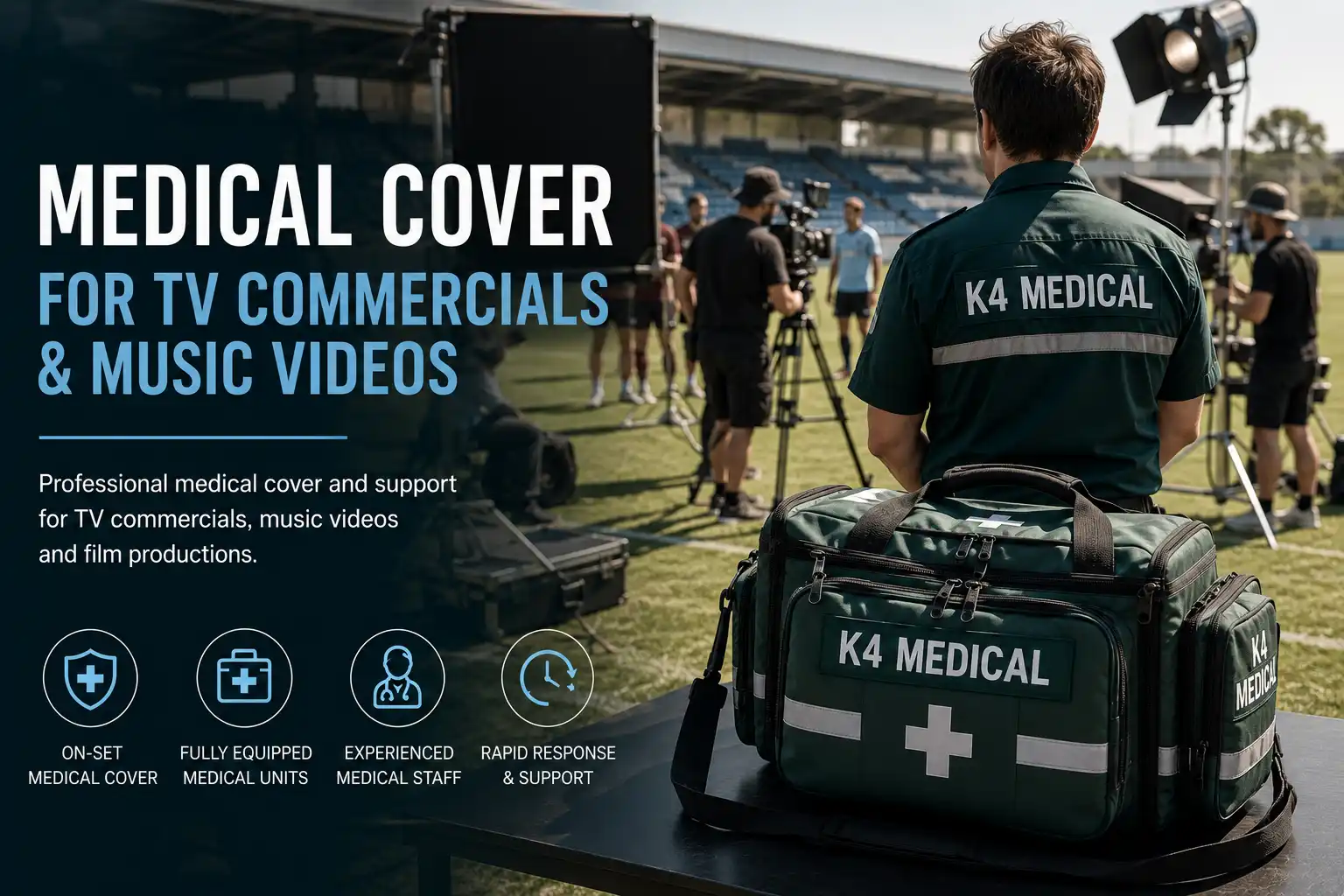
TV commercials and music videos are often treated differently from feature films and drama productions when it comes to medical cover. They are shorter, faster, and usually operate on tighter budgets. Because of that, medical provision is often one of the first things to get cut from the production budget.
That is a mistake. Commercial and music video shoots carry many of the same risks as larger productions, sometimes more, because of the speed at which they move and the creative pressure to get everything done in a single day. In this guide, we explain when you need medical cover, what level is appropriate, and how to get it arranged without blowing your budget.
H2: Do You Need a Medic on a Commercial Shoot?
The short answer is that it depends on your risk assessment. But in practice, most commercial shoots in the UK should have some form of medical provision.
The Health and Safety at Work Act 1974 applies to commercial productions just as it does to feature films. The production company has a duty to assess the risks on set and provide appropriate measures to manage them. Medical provision is almost always one of those measures, even on what seems like a straightforward shoot.
What catches many producers off guard is how quickly a low-risk shoot can become a higher-risk one. A beauty commercial in a studio sounds simple until you add hot lighting, a fog machine, a wet floor for a creative effect, and a model standing on a raised platform in heels. A food commercial seems harmless until someone has an allergic reaction to an ingredient on set. A fashion shoot in a warehouse sounds low-key until someone trips over a cable in a poorly lit space.
Your production insurance will almost certainly have a view on medical cover too. Many policies require evidence of medical provision as a condition of coverage. If an incident happens and you had no medical cover on set, your insurer may refuse the claim.
H2: Music Videos and Their Unique Risks
Music video shoots tend to push creative boundaries more than most commercial work, and that brings specific medical risks that are easy to underestimate.
Performance scenes often involve artists and dancers working at high intensity for extended periods, sometimes in heat, sometimes in cold, and often without adequate breaks because the schedule is tight. Dehydration, exhaustion, and musculoskeletal injuries are common.
Creative setups frequently involve elements that carry genuine risk. Water, fire, smoke machines, haze, confetti cannons, moving vehicles, heights, crowds of extras, and late-night shooting schedules all feature regularly in music video production. Each of these introduces medical risks that a basic risk assessment should identify.
Crowd scenes with extras bring their own challenges. Large groups of people in a confined space, often moving to choreography, create risks of trips, falls, crowd pressure, and anxiety. Having a medic on set who can manage these situations calmly and quickly keeps the shoot moving without compromising safety.
In our experience, music video producers who invest in proper medical cover find that it actually saves time on the day. When a dancer twists an ankle or an extra feels faint, having a professional set medic on-site means the situation is handled in minutes rather than shutting down the entire shoot while someone searches for the nearest walk-in clinic.
H2: What Level of Medical Cover Do You Need?
Not every commercial or music video needs a full paramedic team. The right level of cover depends on the specific risks of your shoot day.
For standard studio shoots with a small crew, no physical activity, and no special effects, a qualified first aider is usually sufficient. They can handle minor injuries, monitor crew welfare during long days, and call for emergency support if something more serious occurs.
For shoots involving moderate risk such as physical performance, outdoor locations, working with food or chemicals, or crews of more than 20 people, an Emergency Medical Technician provides a step up in clinical capability without the cost of a full paramedic.
For higher-risk shoots involving stunts, fire, water, pyrotechnics, working at height, vehicle work, or large crowd scenes, an HCPC-registered paramedic is recommended. For the highest-risk scenarios, a paramedic with ambulance standby gives you rapid evacuation capability if a serious injury occurs.
The key is matching the cover to the risk, not guessing. A five-minute conversation with a medical provider before the shoot can help you determine exactly what you need.
H2: Keeping Costs Down
Budget is always a factor on commercials and music videos, and medical cover needs to fit within it. Here are a few ways to manage costs without cutting corners.
Book early. Providers can often offer better rates when you book in advance rather than scrambling the day before the shoot. If you know your shoot dates, get your medical cover sorted in pre-production.
Be honest about the risk level. If your shoot is genuinely low-risk, you may only need a first aider rather than a paramedic. A good provider will be honest about what you actually need rather than overselling you the most expensive option. K4 Medical provides first aid cover for lower-risk shoots as well as paramedic teams for more complex productions.
Combine shoot days. If you are shooting a commercial and a behind-the-scenes film on the same day, or if you have multiple shoot days in the same week, ask about package rates. Most providers offer multi-day discounts.
Do not skip it entirely. The cost of a set medic for a day is a tiny fraction of your production budget. The cost of a serious injury on set without medical cover, in terms of production delays, insurance complications, and potential legal liability, is incomparably higher.
H2: What Happens on the Day
When you book medical cover for your commercial or music video, here is what to expect.
Your medic arrives before call time, typically 30 minutes early. They check in with the first assistant director or production manager, review the call sheet and risk assessment, and set up a treatment area. During the shoot, they position themselves close to the action but out of shot, ready to respond if needed.
Most of the time, a set medic on a commercial or music video shoot handles minor things. Headaches, plasters, eye drops for someone working near haze, a bit of first aid for a small cut. Quiet, professional, and completely invisible to the final product.
But when something more serious happens, and occasionally it does, having that trained professional right there makes a difference that money cannot buy.