Documentary and factual productions are often seen as lower risk than drama or action-heavy filming. There are no stunts, no pyrotechnics, and usually no large crowds. So it is tempting to assume you do not need medical cover on set.
That assumption can cost you. Documentaries take crews into environments that are unpredictable by nature. Remote countryside locations, derelict buildings, industrial sites, fishing boats, mountainsides, busy urban streets, and environments where the crew has little control over what happens next. The risks might be different from a drama shoot, but they are just as real.
In this guide, we explain what medical cover documentary productions need, when you should have a medic on set, and how to arrange it without overcomplicating your production.
Why Documentaries Need Medical Cover
The Health and Safety at Work Act 1974 applies to documentary productions exactly as it does to any other filming. The production company has a duty to assess the risks at every location and provide appropriate safety measures, including medical provision where the risk assessment calls for it.
What makes documentaries different is that the risks are often environmental rather than scripted. You cannot always predict what will happen because the whole point of factual filming is to capture reality. A crew filming a documentary about mountain rescue might find themselves in genuinely dangerous terrain. A team shooting a food documentary in a commercial kitchen is working around hot oil, sharp knives, and gas burners. A crew filming on a construction site is exposed to the same hazards as the workers there.
In our experience, the documentary productions that run into problems are the ones where nobody thought through the medical provision because the shoot seemed straightforward on paper. The reality on location turned out to be very different.
Your production insurance will also have a view on this. Most policies require evidence that risks have been assessed and appropriate measures are in place. If something happens on set and you have no medical provision, your insurer may question the claim.
Common Risks on Documentary Shoots
Documentary crews face a wider range of risks than many people realise. Some of the most common situations our medics deal with on factual shoots include slips, trips, and falls at outdoor or unfamiliar locations. Weather exposure including heat exhaustion in summer and hypothermia in winter. Allergic reactions to plants, insects, or materials encountered on location. Injuries from equipment being moved and set up quickly in uncontrolled environments. Fatigue and dehydration during long shoot days, particularly when filming in remote areas without easy access to facilities. Encounters with animals, livestock, or wildlife. Road traffic risks when filming near or on roads. And stress and anxiety among contributors who are not professional performers and may find the filming process overwhelming.
For productions involving travel to remote or overseas locations, the distance from the nearest hospital becomes a critical factor. If your crew is two hours from the nearest A&E, having a qualified medic on location is not just sensible. It could be the difference between a manageable incident and a serious outcome.
What Level of Cover Do You Need?
Documentary productions vary enormously in scale and risk, and the medical cover should match. Here is a practical guide.
For standard interviews and studio-based factual content, the risk is low. A nominated first aider from the crew with a well-stocked first aid kit is usually sufficient. Most production teams will already have someone with a current first aid certificate.
For location shoots in controlled environments such as offices, shops, restaurants, or public buildings, a qualified first aider should be on set. The risk is still relatively low, but having someone dedicated to first aid rather than doubling up with another role is good practice.
For outdoor location shoots involving physical activity, water, heights, remote areas, or adverse weather, a set medic with EMT or paramedic-level training is recommended. These are the shoots where things can go wrong quickly and having advanced clinical capability on-site makes a real difference. K4 Medical provides experienced set medics for documentary productions across London, Hertfordshire, and the wider UK.
For high-risk factual content such as survival programmes, extreme sports documentaries, military or emergency services observational filming, or any production involving genuine physical danger, a paramedic with ambulance standby should be considered. The risk profile on these shoots can rival or exceed that of scripted action sequences.
Factual Productions and Contributors
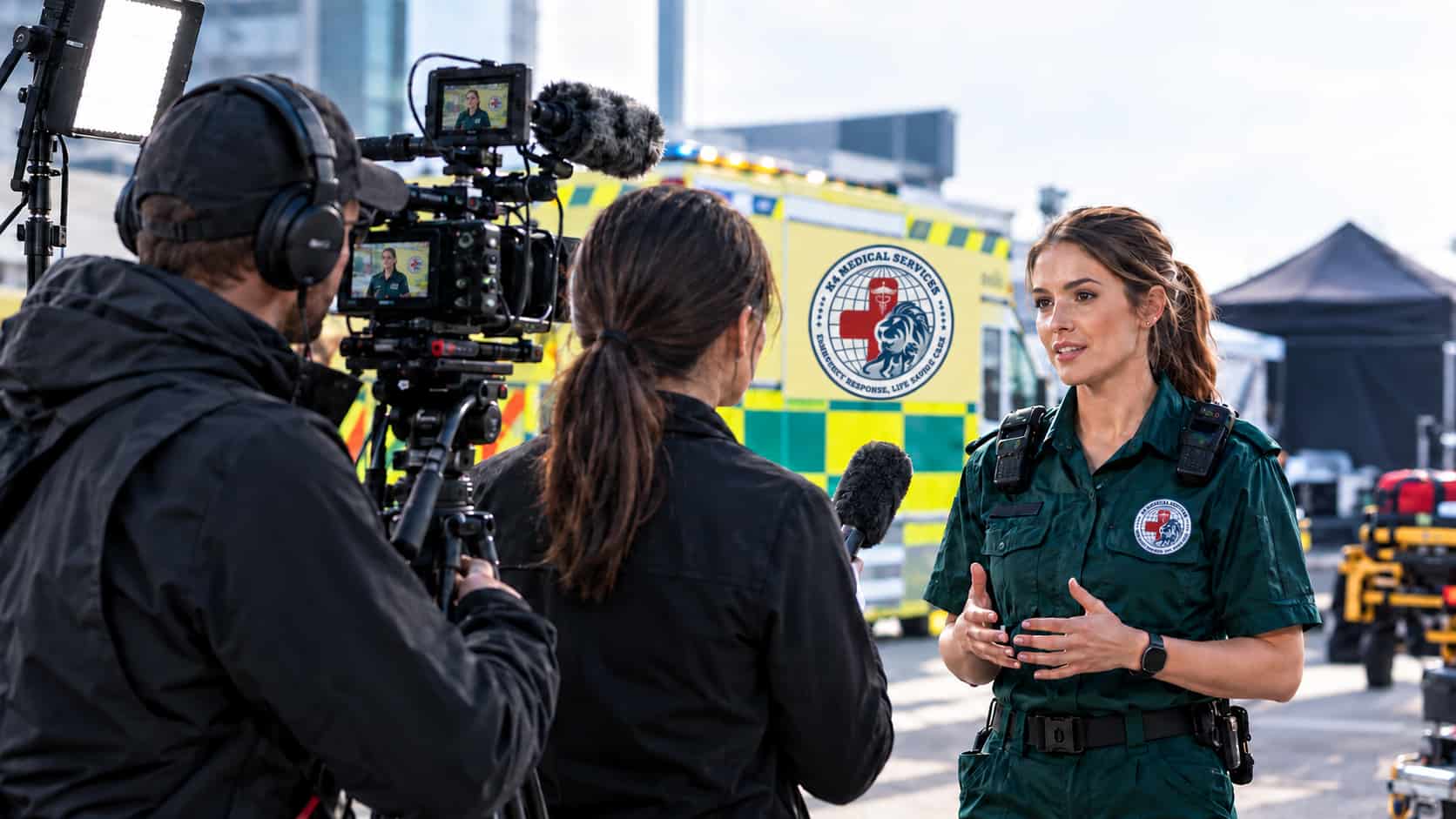
One aspect of documentary filming that does not apply to drama is the involvement of real people as contributors. Professional actors are accustomed to the filming environment, know how sets work, and understand the physical demands. Contributors in documentaries are often members of the public who may be elderly, unwell, anxious, or unfamiliar with anything about the production process.
This means the medic on a documentary shoot sometimes has more of a welfare role than a pure emergency response role. Checking in on nervous contributors, making sure elderly interviewees are comfortable during long filming setups, keeping an eye on anyone who seems unwell, and being a calm, reassuring presence for people who are not used to being on camera.
It is a different kind of medical cover from a stunt day on a drama, but it is no less important. Having someone on set whose specific job is to look after the wellbeing of contributors can make the difference between a smooth shoot and one where someone becomes distressed or unwell and filming has to stop.
Planning Medical Cover for Your Documentary
Getting medical cover sorted for a documentary is simpler than most producers expect.
Start by reviewing your risk assessment for each shoot day and location. Identify any locations where access to emergency services is limited, any activities that carry physical risk, any contributors with known medical conditions, and any environmental factors like weather, terrain, or wildlife. Share these details with your medical provider and let them recommend the right level of cover.
For multi-day documentary shoots, having the same medic throughout the production has real advantages. They get to know the crew, understand the rhythm of the shoot, and build a relationship with contributors that makes the welfare aspect of the role much more effective.
K4 Medical provides film and TV medical services for documentary and factual productions of all sizes. Whether you need a first aider for a single interview day or a paramedic team for a multi-week adventure series, we match the medical provision to your production.
For productions where contributor welfare is a priority, our teams can also provide general welfare and first aid support alongside clinical medical cover.
Call 020 3143 3998 or request a quote with your production schedule and we will recommend the right level of cover for your documentary.