If you are organising a sporting event in the UK, getting the medical cover right is one of the most important decisions you will make. Get it wrong and you are risking the safety of participants, the validity of your insurance, and potentially the future of the event itself.
The challenge is that sporting events are not all the same. A five-a-side football tournament in a local park has very different medical requirements from a half marathon through city streets or a motorsport event on a racing circuit. In this guide, we break down what different types of sporting events need and how to match the medical provision to the risk.
Why Sporting Events Need Medical Cover
Sport involves physical exertion, and physical exertion carries medical risk. That is true whether you are organising a junior athletics day or a professional boxing match. The most common medical incidents at sporting events include musculoskeletal injuries such as sprains, strains, fractures, and dislocations. Cardiac events, which are rare but can occur in any age group during intense physical activity. Head injuries and concussions, particularly in contact sports. Heat exhaustion and dehydration during warm weather events. Hypothermia during cold or wet outdoor events. Asthma attacks triggered by exercise. And spectator injuries from trips, falls, or crowd movement.
The Health and Safety at Work Act 1974 requires event organisers to assess these risks and put appropriate measures in place. For sporting events, that almost always includes some form of medical provision.
Matching Medical Cover to Your Sport
The level of medical cover your event needs depends on the type of sport, the number of participants and spectators, and the risk profile of the activity.
Running events, marathons, and fun runs. Road races are one of the most medically demanding types of sporting event. Participants push themselves physically over long distances, often in warm conditions, and the course may stretch over several miles with limited access points. Run Britain and UK Athletics set out clear medical requirements for running events, including paramedic cover, course-side first aid posts, and ambulance support at the start and finish. Even smaller fun runs and charity 5Ks benefit from having a qualified medic at the finish line.
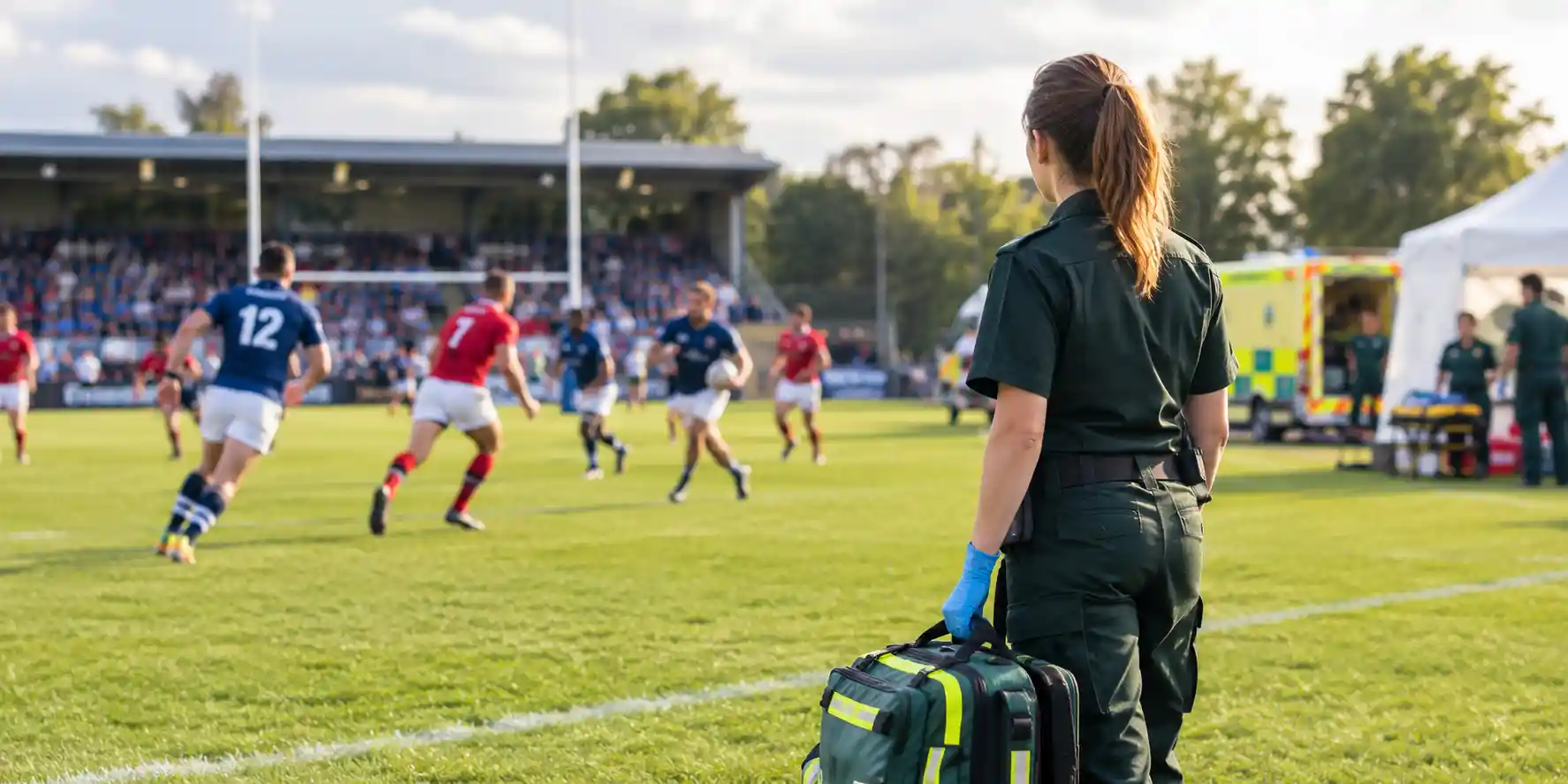
Football, rugby, and contact sports. Contact sports carry a high risk of musculoskeletal injuries and head injuries. National governing bodies including the RFU and FA have their own medical provision standards for competitive fixtures. For local tournaments and club matches, having a qualified first aider or EMT pitchside is the minimum standard. For larger tournaments, a paramedic with trauma management capability is recommended.
Cycling and triathlon events. These events combine physical endurance with speed and traffic, creating a complex risk profile. Course-side medical teams need to be mobile, often using cycle response units or rapid response vehicles to reach incidents quickly. Medical staff should be experienced in managing road traffic injuries as well as the usual exercise-related conditions.
Motorsport and karting. Motor racing carries some of the highest medical risks of any sport. Burns, impact injuries, and high-speed trauma all require advanced clinical capability at the trackside. Motorsport medical cover should include an HCPC-registered paramedic with trauma experience, ambulance standby with extrication capability, and a treatment area near the circuit.
Cricket, athletics, and lower-contact sports. While the risk of serious injury is lower, these events still need first aid provision for common issues like muscle strains, impact injuries from balls or equipment, and heat-related illness during summer fixtures. A qualified first aider is usually sufficient for club-level events.
Swimming and water-based events. Any event involving water requires specific medical planning for drowning risk, cold water shock, and hypothermia. Lifeguard provision is separate from medical cover, and both should be in place for open water events.
What the Governing Bodies Expect
Most national governing bodies have their own medical provision standards that apply to events held under their rules. Some of the key ones include Run Britain for running events, which specifies medical provision based on race distance and participant numbers. The RFU for rugby, which requires qualified medical cover at all competitive matches. The FA for football, with specific requirements for tournaments and cup fixtures. British Cycling for cycling events. And Motorsport UK for racing and karting events, which has detailed medical requirements including paramedic teams and rescue units.
If your event is sanctioned by a governing body, check their specific requirements early in your planning. Non-compliance can result in the event being refused or cancelled. K4 Medical has provided event medical services for sporting events including the Putney and Fulham Half Marathon, Richmond Rugby Club matchdays, and the Retro Kart Championship, all compliant with the relevant governing body standards.
Staffing Levels and Equipment
As a general guide, smaller sporting events with up to 200 participants need at least one qualified first aider with a well-stocked first aid kit and a defibrillator. Medium events with 200 to 1,000 participants should have a team of first aiders plus an EMT or paramedic, with additional equipment including oxygen, trauma supplies, and stretchers. Large events with over 1,000 participants and spectators will typically require a full medical team including paramedics, multiple treatment posts across the venue, ambulance standby, and a communication system linking the medical team with event control.
For events held at venues far from hospital, or events involving high-risk sports, upgrading to a paramedic team with ambulance capability should be standard regardless of the participant numbers.
Risk Assessment Is the Starting Point
Every sporting event should begin with a documented risk assessment that specifically addresses medical provision. The risk assessment considers the type of sport and its inherent risks, expected participant numbers and fitness levels, spectator numbers and crowd management, venue layout and distance from the nearest hospital, weather conditions and time of year, whether alcohol will be available, and the age profile of participants and spectators.
From this assessment, the appropriate level of medical cover becomes clear. A good medical provider will help you carry out this assessment and recommend staffing levels and equipment based on the findings rather than guessing. K4 Medical provides free risk assessments for sporting events of all sizes.
If your event also needs first aid cover for school sports or a welfare team for spectator areas, we can combine these into a single package.
Book Sports Event Medical Cover
Whether you are organising a local fun run, a rugby tournament, a cycling sportive, or a motorsport event, K4 Medical provides professional medical cover matched to your sport and your risk profile.