School trips and sports days are some of the best parts of the school year. But they also take children out of the familiar environment of the classroom and into situations where the risk of injury goes up. Twisted ankles on the football pitch, asthma attacks during cross-country, allergic reactions at a picnic, a child falling at an adventure park. These things happen, and when they do, having proper first aid arrangements in place is not optional.
In this guide, we explain what the law requires, what OFSTED expects, and how to make sure your school trips and sports days have the right level of first aid cover.
What the Law Says
The Health and Safety at Work Act 1974 and the Health and Safety (First-Aid) Regulations 1981 both apply to school trips and off-site activities just as they apply to the school itself. The school has a legal duty to ensure the health and safety of pupils during any activity it organises, whether that activity happens on school grounds or fifty miles away.
The DfE guidance on health and safety for school trips is clear. Schools must carry out a risk assessment for every off-site visit. That risk assessment must identify what first aid provision is needed, and the school must ensure that provision is in place before the trip goes ahead.
For residential trips and adventurous activities, the requirements are even more specific. The school must ensure that a qualified first aider is present for the duration of the trip, that a suitable first aid kit is carried, and that there is a clear plan for managing medical emergencies including how to contact local emergency services at the destination.
One thing that catches many schools out is the assumption that the venue will provide first aid cover. Some venues do, but many do not. And even when a venue has its own first aiders, the school retains its duty of care for its pupils. Relying entirely on the venue is not enough.
Sports Day First Aid Requirements
Sports days carry specific medical risks that a normal school day does not. Children are running, jumping, throwing, and competing in physical activities that increase the chance of sprains, strains, fractures, and head injuries. Add in warm weather and you have the additional risks of heat exhaustion, dehydration, and sunburn.
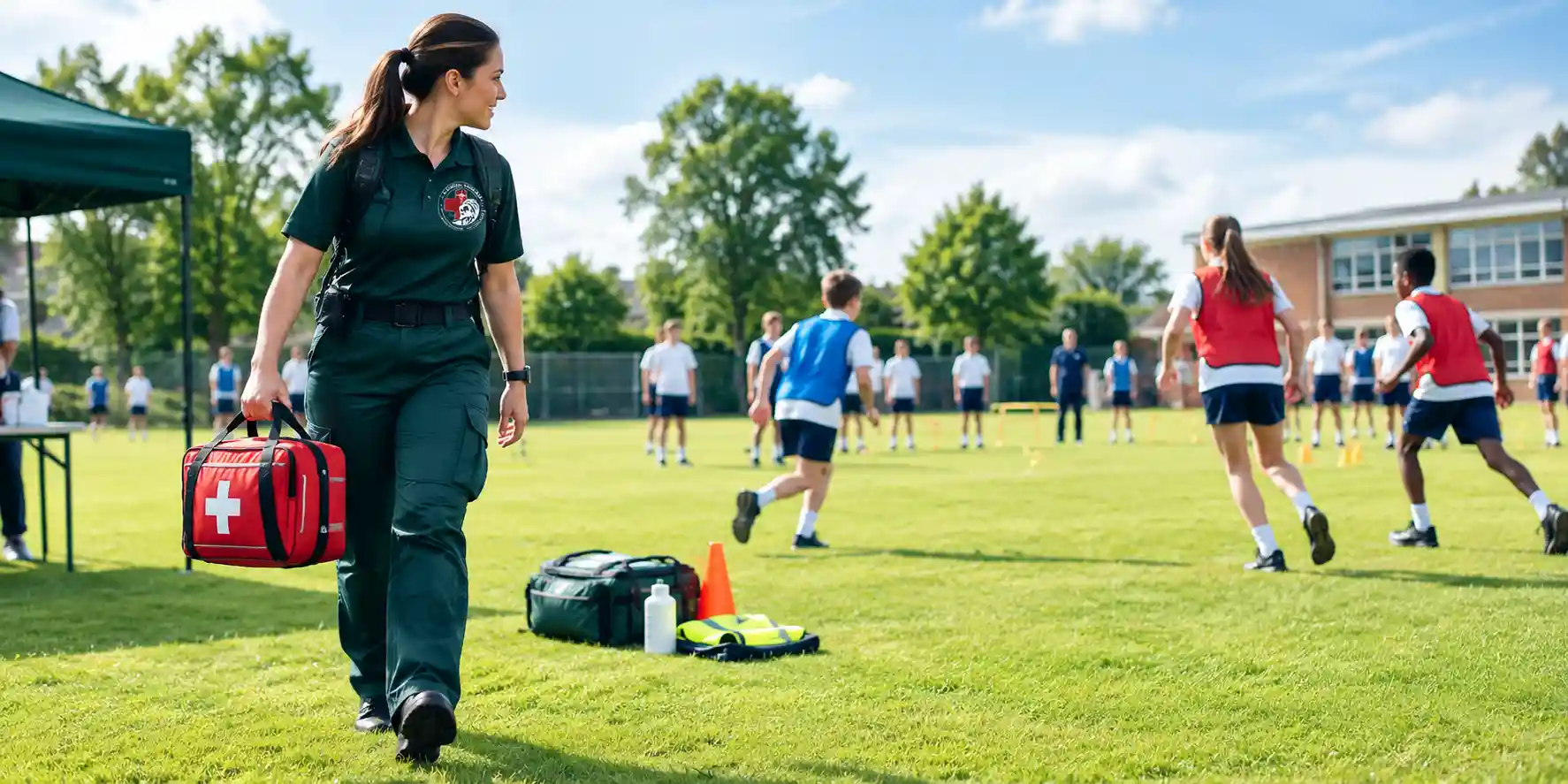
At minimum, a sports day should have at least one qualified first aider on duty who is not also responsible for supervising or organising events. This is important. If your only first aider is also running the Year 5 egg and spoon race, they are not available to respond to the Year 3 child who has just fallen on the track.
A properly stocked first aid kit should be easily accessible at the field or sports area, not locked in the school office. For larger sports days involving multiple year groups or external participants, additional first aiders may be needed to cover different areas of the site.
In our experience, the sports days that run most smoothly from a safety perspective are the ones where the school has booked a dedicated first aid provider rather than relying on staff who have other responsibilities on the day. A professional first aider whose only job is to manage medical incidents means teachers can focus on the children and the events.
What Should Be in Your First Aid Kit for Trips and Sports Days
The contents of your first aid kit should be based on your risk assessment, but HSE guidance provides a minimum standard that every kit should meet. This includes assorted plasters, sterile wound dressings in various sizes, triangular bandages, safety pins, disposable gloves, sterile eye pads, antiseptic wipes, and a foil blanket.
For school trips and sports days specifically, you should also consider adding an instant cold pack for sprains and bumps, a thermometer, sun cream and shade provisions for outdoor summer events, asthma inhalers for pupils with known asthma, prescribed EpiPens or antihistamines for pupils with known allergies, and any other medication specified in a pupil’s individual healthcare plan.
All medication should be clearly labelled with the pupil’s name and stored according to the school’s medicines policy. The first aider should know which pupils have medical conditions and where their medication is kept before the trip or event begins.
Staff Ratios and First Aid Training
The DfE does not prescribe specific staff-to-pupil ratios for first aid on school trips, but it does require schools to ensure that ratios are appropriate for the activity, the age of the children, and the identified risks. As a general guide, most schools apply a ratio of one adult to every ten to fifteen pupils for day trips, with higher ratios for younger children and activities involving water or heights.
Among those adults, at least one should hold a current first aid qualification. For trips involving Early Years children, a paediatric first aider must be present as required by the EYFS framework. For school trips abroad, the school should also confirm what emergency medical services are available at the destination and ensure the group leader knows how to access them.
For sports days, the number of first aiders needed depends on the scale of the event. A small school sports day with 100 pupils might manage with one first aider. A larger event with 400 or more children, particularly one involving parents and visitors, should have at least two first aiders covering different areas.
Residential Trips and Adventure Activities
Residential trips and adventurous activities such as rock climbing, kayaking, orienteering, and mountain walks carry higher risks and require more robust first aid planning.
The school should verify that the activity provider holds the relevant accreditation, such as Adventure Activities Licensing Authority certification where applicable. The school must also ensure that its own first aid provision covers the full duration of the residential stay, including overnight. Having a first aider available only during activity hours is not sufficient if a child falls ill at midnight.
For remote residential locations where access to emergency services may be limited, schools should consider whether a higher level of medical cover is appropriate. K4 Medical provides first aid cover for school trips including residential visits, adventure activities, and Duke of Edinburgh expeditions. Our DBS-checked first aiders travel with the group and provide dedicated medical cover throughout the entire trip.
Common Mistakes Schools Make
Having covered hundreds of school events, we have seen a few recurring mistakes that are worth highlighting.
Assuming the venue provides first aid. Always check, and even if they do, confirm what level of cover is provided and whether it is adequate for your group size. Not briefing the first aider on pupils with medical conditions. The first aider should receive a list of children with asthma, allergies, epilepsy, or any other condition before the trip. Packing the first aid kit in the boot of the coach. It needs to be accessible during the journey, not just at the destination. Relying on a staff member whose first aid certificate expired last year. Check expiry dates during trip planning, not on the morning of departure. And not having a plan for what happens if a child needs hospital treatment. Who goes with them? Who stays with the group? Who contacts the parents? These decisions should be made in advance.
Need First Aid Cover for Your Next School Trip?
K4 Medical provides professional, DBS-checked first aiders for school trips and sports days across London and South East England. Our team handles the medical cover so your teachers can focus on the children.
For larger school events where additional medical support is needed, we also provide event medical services including paramedic cover and on-site treatment areas.