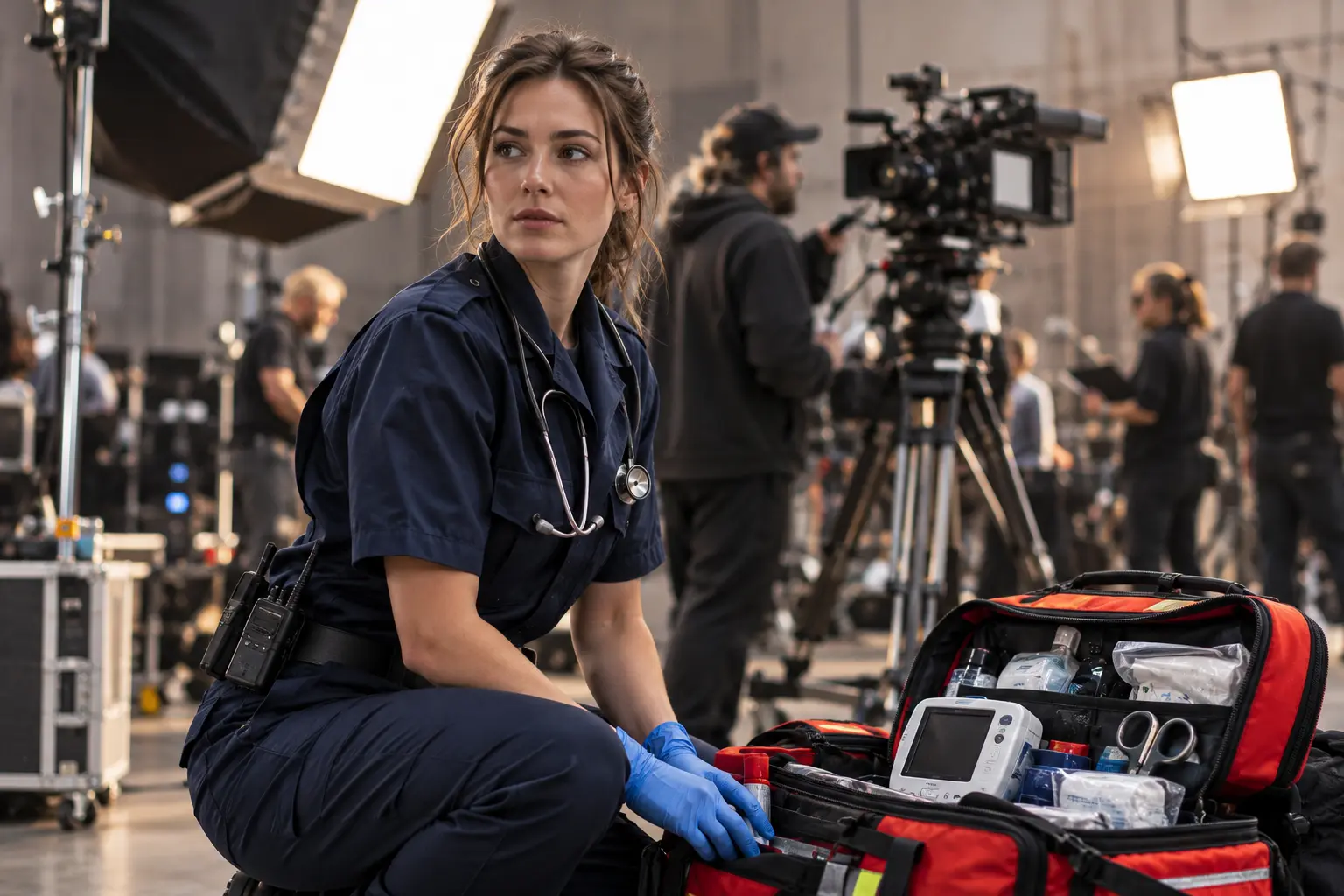
Working as a set medic is one of the most interesting careers in the medical field. One day you are treating a minor burn on a period drama in the countryside. The next you are on standby for a stunt sequence on a rooftop in Central London. No two days are the same, and the people you work with are unlike those in any hospital or ambulance station.
But getting into the role is not always straightforward. There is no single course called “set medic training” and no governing body that issues a set medic licence. The path into this work depends on what qualifications you already hold and what kind of productions you want to work on.
Here is how it actually works.
What Qualifications Do You Need?
The qualifications needed to work as a set medic in the UK depend on the level at which you want to work. There are broadly three entry points.
FREC Level 3 (First Responder) is the minimum qualification accepted by most medical providers for film and TV work. FREC 3 is the equivalent of a Community First Responder within the NHS framework. It covers basic life support, patient assessment, wound care, and the management of common medical emergencies. The course typically takes around five days and is available through providers regulated by Ofqual. If you are starting from scratch with no medical background, this is the most accessible route in.
FREC Level 4 or 5 (Emergency Care Assistant or Technician) takes things further. These qualifications sit higher on the Pre-Hospital Emergency Medicine skills framework and are more closely aligned with NHS ambulance crew roles. FREC 4 is equivalent to an NHS Emergency Care Assistant, and FREC 5 sits at Technician level. Productions with higher risk profiles, such as those involving stunts or remote locations, will often require medics at this level or above.
HCPC-Registered Paramedic is the gold standard for set medic work. Paramedics can administer medication, perform advanced airway management, set up IV access, and make independent clinical decisions on set. To become a paramedic in the UK, you need to complete a three-year BSc in Paramedic Science at an approved university and register with the Health and Care Professions Council. If you are already a qualified paramedic, you are immediately eligible for the highest level of set medic work.
There is an important point here that a lot of people miss. You cannot work as a professional set medic in the UK with just a basic three-day First Aid at Work certificate. It is not enough for the clinical demands of the role, and reputable medical providers will not deploy staff at that level on a production set.
What Other Requirements Are There?
Beyond your clinical qualification, there are several other things you will need before you can start working on set.
A current Enhanced DBS check is essential. You will be working alongside cast and crew in close quarters, and many productions involve child performers. Without a clean DBS, you will not get through the door.
Professional indemnity insurance covers you for the clinical decisions you make on set. Most medical providers arrange this for their staff, but if you are working freelance, you will need your own policy.
Experience matters more than most people expect. A qualification alone does not make you ready for set work. Spending time working at events, festivals, and community gatherings through a provider like K4 Phoenix EMS is one of the best ways to build practical experience in environments that share many similarities with film sets. You learn to work in uncontrolled settings, manage your own equipment, make independent clinical decisions, and deal with whatever turns up.
Understanding how a film set works is just as important as your medical skills. You need to be comfortable reading a call sheet, know when to stay out of the way, understand the chain of command on a production, and know that the first assistant director is your main point of contact for anything operational. None of this is taught in a medical course. You learn it by doing it.
What Does a Set Medic Actually Do Day to Day?
The reality of set medic work is quieter than most people expect. The majority of your time is spent on standby, positioned close to the action but out of shot, ready to respond if something happens. Most days, nothing serious does.
You arrive before the crew, usually 30 minutes before call time. You check in with the first AD, review the call sheet for the day, set up your treatment area, and walk the set to check for hazards. During filming, you stay close and stay alert. Between setups, you deal with whatever comes your way. Headaches, blisters, eye drops for someone working near haze, a plaster for a paper cut. It is routine, and that is exactly how it should be.
When something more serious happens, and occasionally it does, that is when your training earns its keep. A fall from a rig, a burn from a lighting fixture, a cardiac event, or an allergic reaction to prosthetics. You assess, you treat, you stabilise, and if necessary, you arrange evacuation. Having ambulance standby on set for high-risk shoot days means you can get a patient to hospital quickly when the situation demands it.
The best set medics are the ones nobody notices until they are needed. Quiet, professional, and ready.
How to Get Your First Set Medic Job
Breaking into set medic work can feel difficult because most production companies want experience, but you need a job to get experience. Here is how to get around that.
Start with events and community work. Medical providers like K4 Phoenix EMS hire medics for festivals, sports events, and community gatherings as well as film and TV productions. Working events builds the same core skills you need on set, including independent clinical practice, working in uncontrolled environments, and managing your own equipment and time.
Register with medical providers who supply crew to the film industry. Companies like K4 Phoenix EMS provide set medics for productions across London, Hertfordshire, and the wider UK. Getting on the books with a provider means you get offered work as it comes in, and they handle the insurance, logistics, and client relationships.
Build a profile on production crew databases. Websites like ProductionBase, Mandy, and StarNow list crew for film and TV productions. Create a profile, list your qualifications, and make it clear you are available for set medic work.
Network at industry events and through social media. LinkedIn and Instagram are both used actively by UK production professionals. Post about your work, share your experience, and connect with line producers, health and safety supervisors, and production managers.
What Can You Earn?
Set medic pay in the UK varies depending on your qualifications and the type of production. As a general guide, medics with FREC 3 or 4 qualifications typically earn a competitive daily rate for standard productions. Paramedics command a higher rate, particularly for productions involving stunts, pyrotechnics, or remote locations.
Most set medics work freelance or through a medical provider, so income depends on how many shoot days you work. Some weeks you might work five or six days across different productions. Other weeks might be quieter. Building relationships with providers and production companies helps maintain a steady flow of work.
Ready to Start?
If you are a qualified medic looking to work in film and TV, or if you are just starting out and want to build experience through event medical work, K4 Phoenix EMS is always interested in hearing from talented, reliable medical professionals.
Visit our Film & TV Medical Services page to learn more about the productions we support, or call 020 3143 3998 to discuss opportunities.